

After spending three weeks at the COIN lab, Davy flew back to LA last weekend.
Visitor

Dr. Davy Weissenbacher from the Cedars-Sinai Medical Center in Los Angeles, USA will stay in the COIN Lab for three weeks starting today.
博士号取得

当研究室から豊田工業大学シカゴ校(TTIC: Toyota Technological Institute at Chicago)の博士課程に進学した米田拓真君が現地時間の8月6日に公聴会を終えて博士号を取得できることが決まりました。当研究室に所属していた学生としては5人目の博士号取得者であり、TTICに当研究室から進学した学生としては2人目です。
TTICはシカゴ大学の計算機科学科と一体で運営されており、多くのシカゴ大学の学生がTTICの講義を受講しています。そのため学生のレベルが非常に高く、特に機械学習と計算複雑性に関連する分野では世界トップレベルです。
研究室分割
2024年度から知能数理研究室は、三輪先生の教授昇任にともない知能数理研究室と知識データ工学研究室に分かれます。学生数も大体同じぐらいに分かれます。ホームページは随時アップデートします。
2023年度卒業・修了式
博士1名、修士2名、学部5人が卒業式を迎えました。

言語処理学会年次大会2024 若手奨励賞

当研究室の博士学生の牧野晃平君が、言語処理学会年次大会の若手奨励賞を受賞しました。以前、プログラム委員長を務めた関係で選考に関わった経験がありますが、数多くの秀逸な論文の中から、若手奨励賞に選ばれるのは至難の業です。2016年に当時M2の山根君が上位語・下位語とそのクラスタの同時学習で若手奨励賞に選ばれて以来の受賞になります。選考に関わった委員の皆様の苦労は良くわりますので、感謝の言葉しかありません。
| P10-10 | 訓練可能なk近傍Retrieverで関係抽出事例を導入したニューラルプロンプティング |
| 牧野晃平 (豊田工大) | |
| 本研究は,近傍事例を用いたLLMによる関係抽出において,近傍事例選択Retrieverと関係抽出LLMの学習を同時に行うend-to-end学習を実現しました.既存研究のRetrieverは微分不可能な操作であったためRetrieverとLLMは個別に学習する必要がありましたが,本研究ではRetrieverの事例選択を埋め込み表現に変換し,更に,LLMの入力をソフトプロンプトで行うことで,end-to-end学習を可能としています.これにより関係抽出に適したRetrieverの学習が実現できると期待され,アイデアの新規性も認められるため,本研究は若手奨励賞に値すると判断しました. |
フランス大使館からの見学者

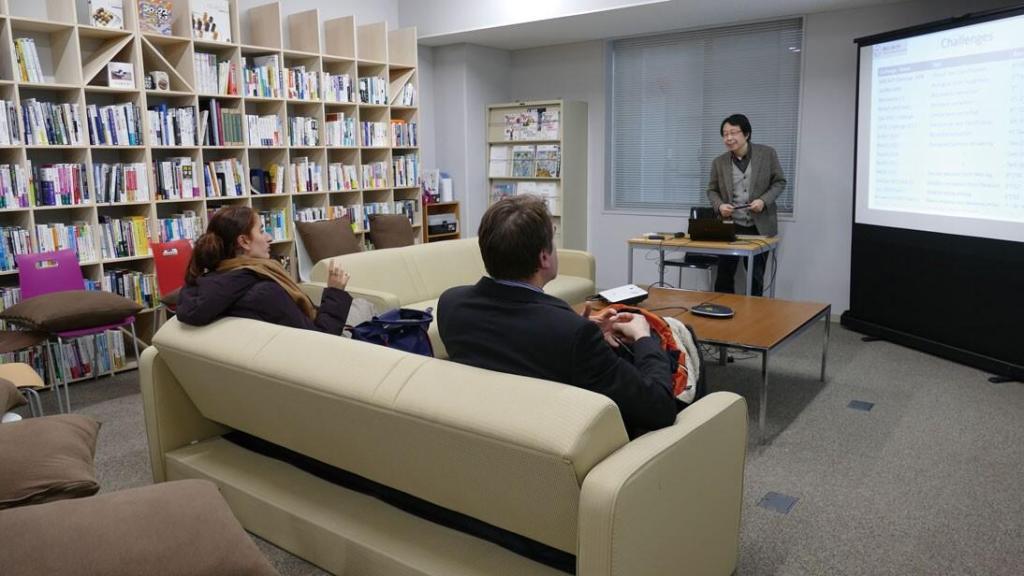
2024年3月5日、フランス大使館 科学技術部の科学技術担当官のジャン=バティスト・ボルド博士とベネディクト・ギユマン プロジェクトマネージャーに当研究室を見学いただきました。
博士号取得
知能数理研究室の博士課程の辻村君が2月に公聴会を行い博士号を取得しました。博士課程在学中に3本のジャーナル論文を発表し、そのうち2本は Journal of Biomedical Informatics (IF=8) に筆頭著者として論文を通しています。n2c2のシェアードタスクでも2019年と2022年に世界一の性能を達成するなど堂々たる成果で博士課程を修了しました。
Computer Speech & Language

Computer Speech & Languageに論文がアクセプトされました。
Savong Bou, Makoto Miwa, Yutaka Sasaki, Two evaluations on Ontology-Style Relation annotations, Computer Speech & Language, Elsevier, 2023. (accepted) (IF=4.3) (doi:https://doi.org/10.1016/j.csl.2023.101569)
NB: Currently, a pre-proof version is available online. There will be some minor revisions applied to the pre-proof version.
2年前に投稿してやっと採録されました。査読でもめたという感じではなく、単純に1ラウンドの査読が1年という時間スパンで動いているためです。
Accepted for JBI
Another full paper has been accepted for publication in the Journal of Biomedical Informatics.
Tomoki Tsujimura, Makoto Miwa, Yutaka Sasaki, Large-scale neural biomedical entity linking with layer overwriting, Journal of Biomedical Informatics, Elsevier, 2023. (to appear) (IF=8)
This paper reports a pure neural entity linking model that can link each entity to one of millions of biomedical concept classes. As the number of concepts which are included in a training set is much smaller than the real size of biomedical databases, we augment the training data with terms and synonyms of database entries and conduct two step training. The first step is ordinary training with all the data (i.e. original training data+ augmented data) and then the second step conducts layer overwriting at the final output layer. This trick is not easy to explain in short but it is clearly effective to improve test scores.
 Computational Intelligence Laboratory, TTI, Japan
コメントを投稿するにはログインしてください。